
A carton’s basic weight is the number that determines how much paper goes into each box. On our floor, paper is 70–80% of the total cost of a carton box. Get it wrong, and the price you quote is off: either too expensive and you lose the tender, or too cheap and your margin is gone. Here’s how to work it out correctly.
Why it isn’t as simple as adding up the basis weights
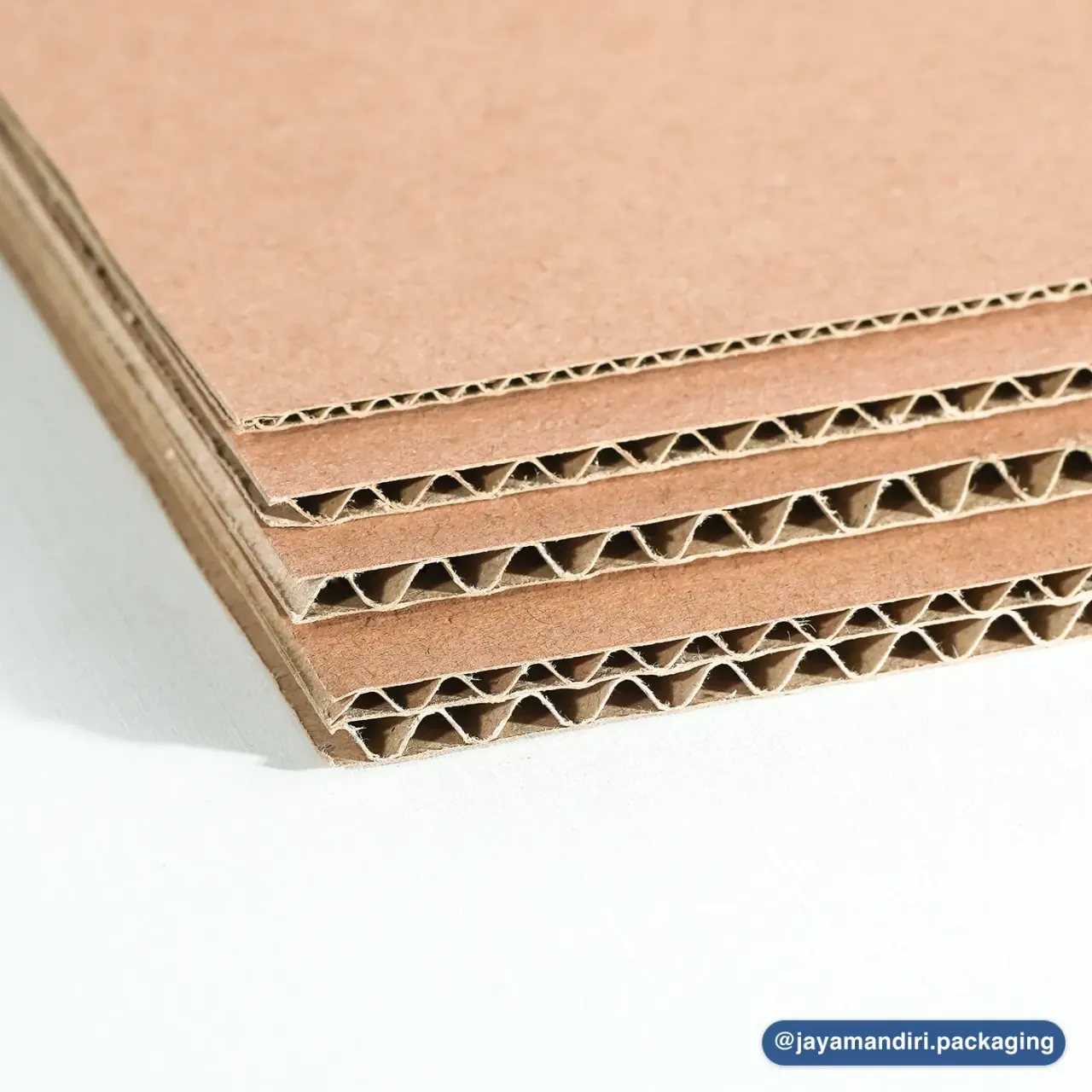
A corrugated sheet has several layers of paper — the outer liner, the medium (the fluted layer), and the inner liner — each with a different basis weight. If you just add up the basis weight of each layer, the result is wrong, because the fluted medium layer needs more paper than its flat surface suggests.
For example: 1 square metre of board takes 1.32 square metres of B-flute medium, because the paper runs up and down the flutes. That’s why the medium’s basis weight has to be multiplied by a factor — the Take Up Factor (TUF).
Take Up Factor table per flute
The Take Up Factor is the ratio of the paper’s length inside the flute structure compared to the length of its flat sheet:
| Flute type | Take Up Factor (TUF) |
|---|---|
| A-flute | 1.54 |
| B-flute | 1.32 |
| C-flute | 1.44 |
| E-flute | 1.27 |
The liner (the flat surface) isn’t multiplied by anything — its factor is 1.00. That includes the middle liner of a double wall board: it is flat, so its factor is 1.00 even though it is often made from medium-grade paper.
The formula
Basic weight per layer = basis weight × Take Up Factor
Total basic weight = the sum of the basic weights of all layers
Worked example
Take a double wall carton with a K150 / M125×3 / K125 structure (a C/B flute combination), one of the structures we actually run. A double wall board has five layers: an outer and inner liner, two fluted mediums, and one middle liner between them. Of the three M125 layers, only two are fluted:
| Layer | Basis weight | TUF | Basic weight |
|---|---|---|---|
| K150 (outer liner) | 150 gsm | 1.00 | 150 gsm |
| M125 (medium, C-flute) | 125 gsm | 1.44 | 180 gsm |
| M125 (middle liner, flat) | 125 gsm | 1.00 | 125 gsm |
| M125 (medium, B-flute) | 125 gsm | 1.32 | 165 gsm |
| K125 (inner liner) | 125 gsm | 1.00 | 125 gsm |
Total basic weight = 150 + 180 + 125 + 165 + 125 = 745 gsm.
The most common mistake is multiplying the middle liner by a Take Up Factor as if it were fluted too. In this example that gives about 800 gsm, 55 gsm (about 7%) too heavy, and the error carries straight into the price. Which flute sits outside, C or B, does not change the total.
That 745 gsm figure is the basis for calculating paper requirement, shipping weight, and ultimately the price per box.
Drop one liner grade, then prove it
The same formula is how we look for savings. Swap the K150 outer liner for K125 and the example above drops from 745 to 720 gsm: 25 grams less paper in every square metre. With paper at 70–80% of the box cost, a difference that small shows up in the price straight away.
But lighter is not automatically strong enough, and no table can tell you that. The answer is in your warehouse and on your line, with your own goods. So we don’t change a spec on the arithmetic alone: we make the lower-grammage version for you to trial on site first, and switch only once it has proven it still carries the load.
Why this number matters
- Cost estimation. Basic weight × box area = paper requirement. This is what translates a part spec into a price.
- Logistics. Basic weight determines the total shipment weight — which affects freight cost and truck-loading efficiency.
- Strength. The right structure and basis weight keep a box stack-resistant without paying for excess paper.
- Material efficiency. Knowing the basic weight means not over-speccing — less paper, less cost, less waste.
At JMP, this basic-weight calculation is exactly what we use to convert your part spec into a structure and a price — built from zero, not pulled off a catalogue. Have a part that needs calculating? Send us the part details or a drawing, and we’ll run the numbers first.
Source: PT Jaya Mandiri Packaging (JMP) — carton box & polybag manufacturer for the automotive industry since 1990. jayamandiripackaging.com