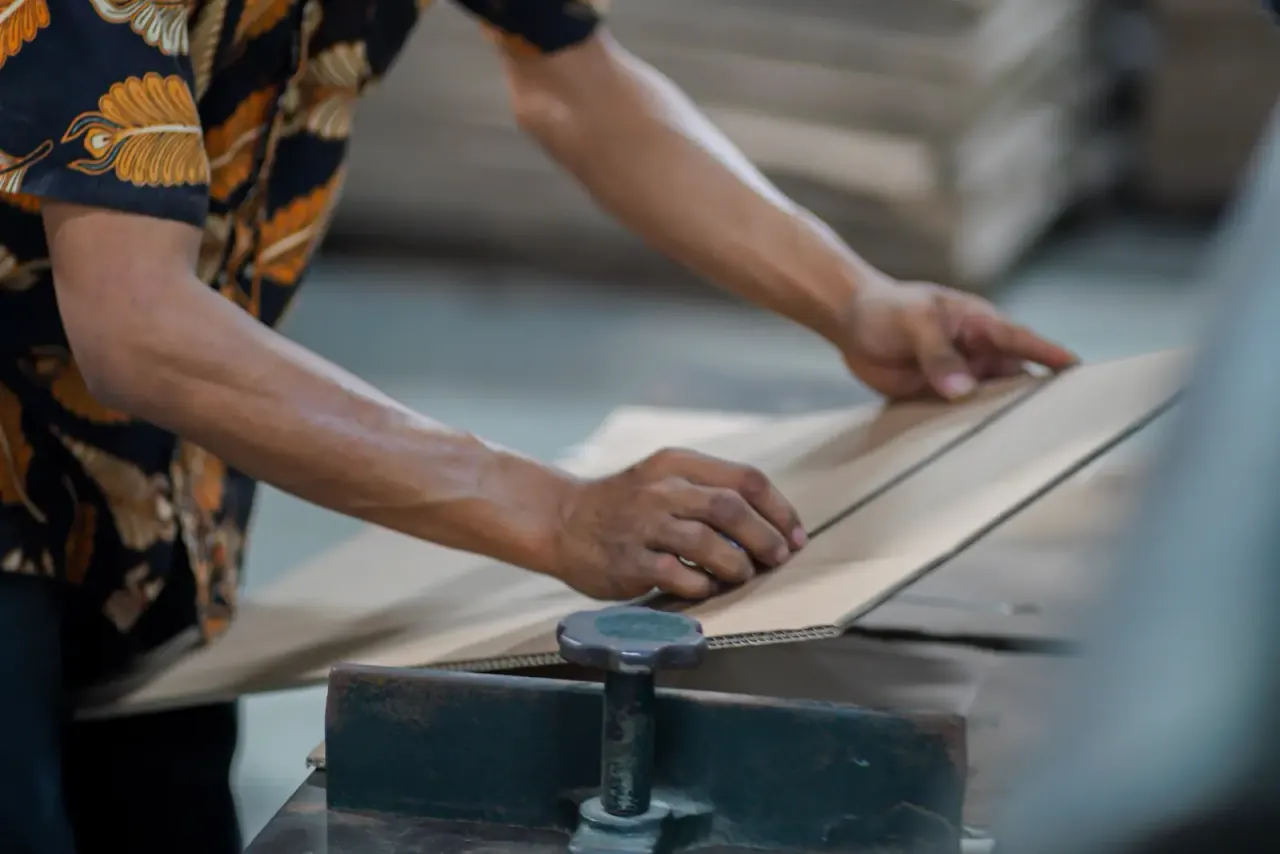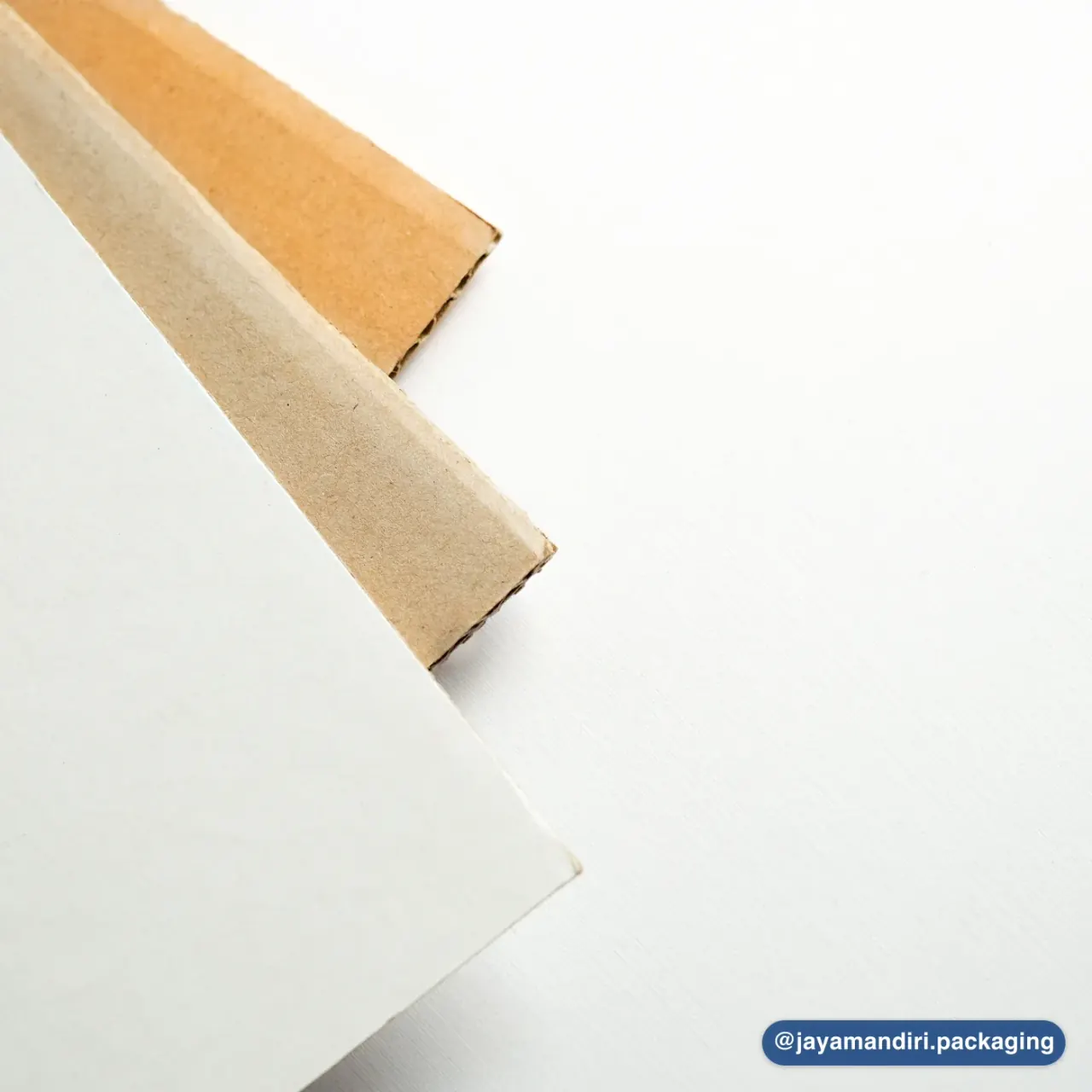
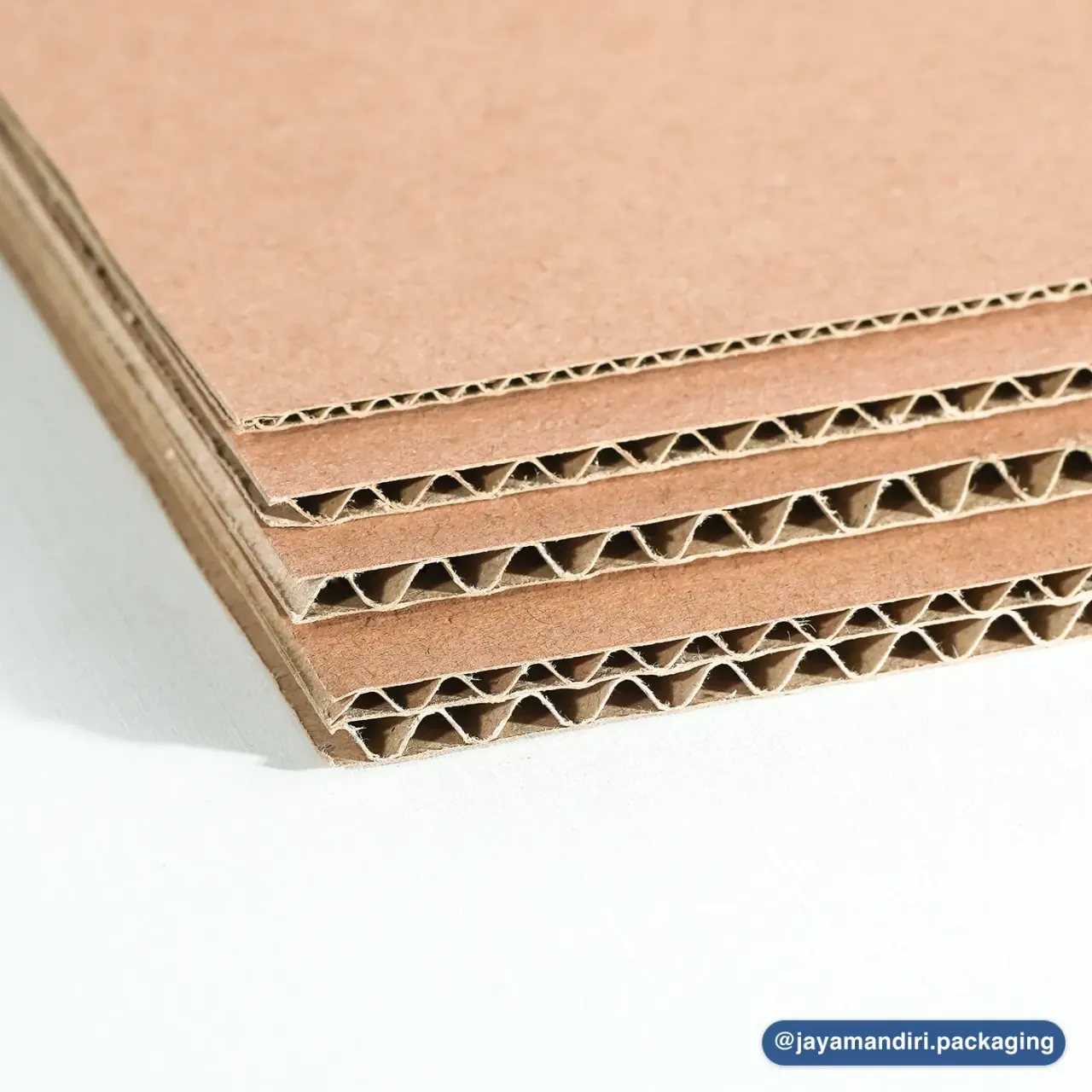
Flute decides two things that pull against each other: how much stacked load your box can take, and how much paper you pay for it. Go up a profile — the box gets stronger, but it also costs more and eats more truck space. Go down, and you save money right up until the bottom box in the third stack caves in.
Four things in this piece: what the wave actually does, the height of each profile, the one thing that is almost always missing from a spec sheet (flute direction), and how to choose without guessing.
Why a wave, and not just thicker paper
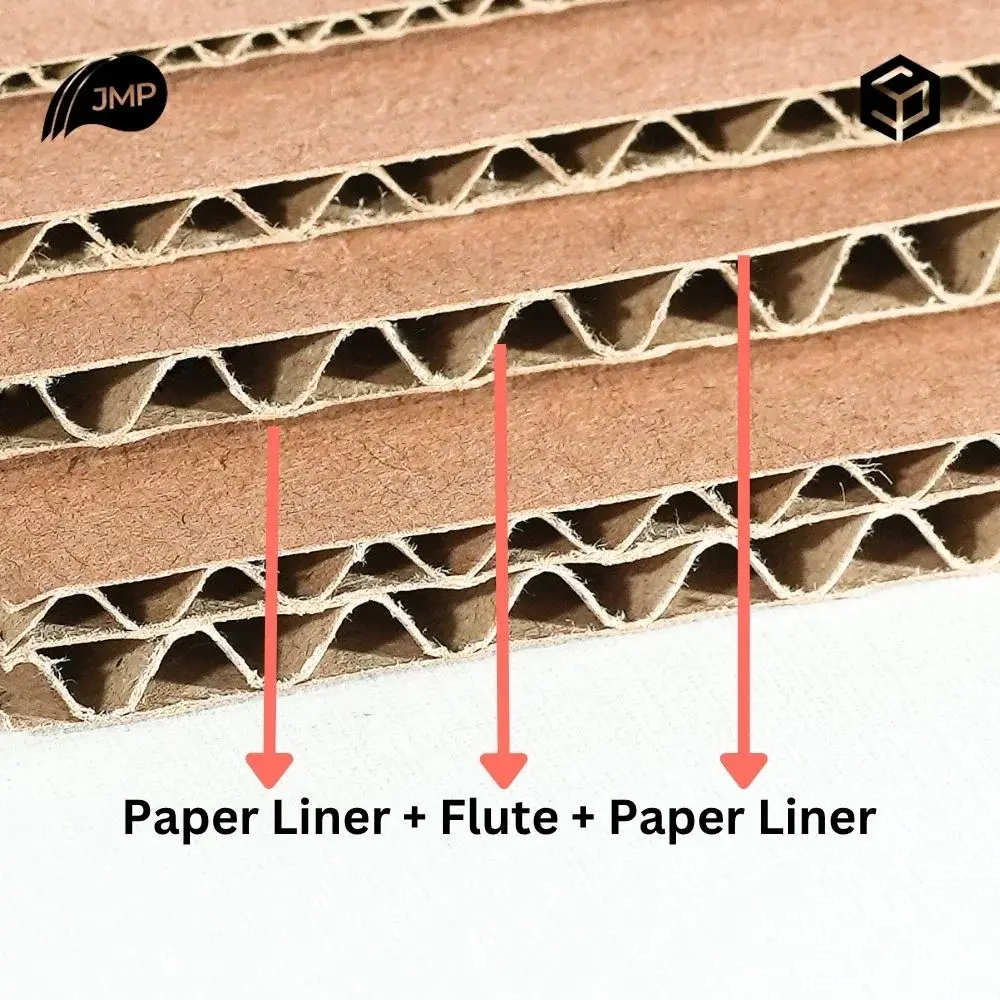
A corrugated sheet is three layers: outer liner, a fluted medium in the middle, inner liner. What makes it strong is not its thickness — it’s its shape. Each flute stands like a small column between the two liners, and a load from above is carried by thousands of those columns at once.
The consequence is immediate, and it’s the part that usually gets lost: the strength lives in the direction the flutes stand. No thickness of flat paper catches up — which is also why flute direction, further down, matters more than most spec sheets admit.
The height of each profile
| Flute | Total board thickness (approx.) | Best for |
|---|---|---|
| E | ~1.5 mm | Small boxes, light parts, detailed print, packaging that has to look sharp |
| B | ~3 mm | General-purpose boxes, good against surface pressure and puncture, single wall |
| C | ~4 mm | Medium–large master boxes, better cushioning and stacking strength |
| BC | ~7 mm | Heavy parts, high stacks, long-distance shipping (double wall) |
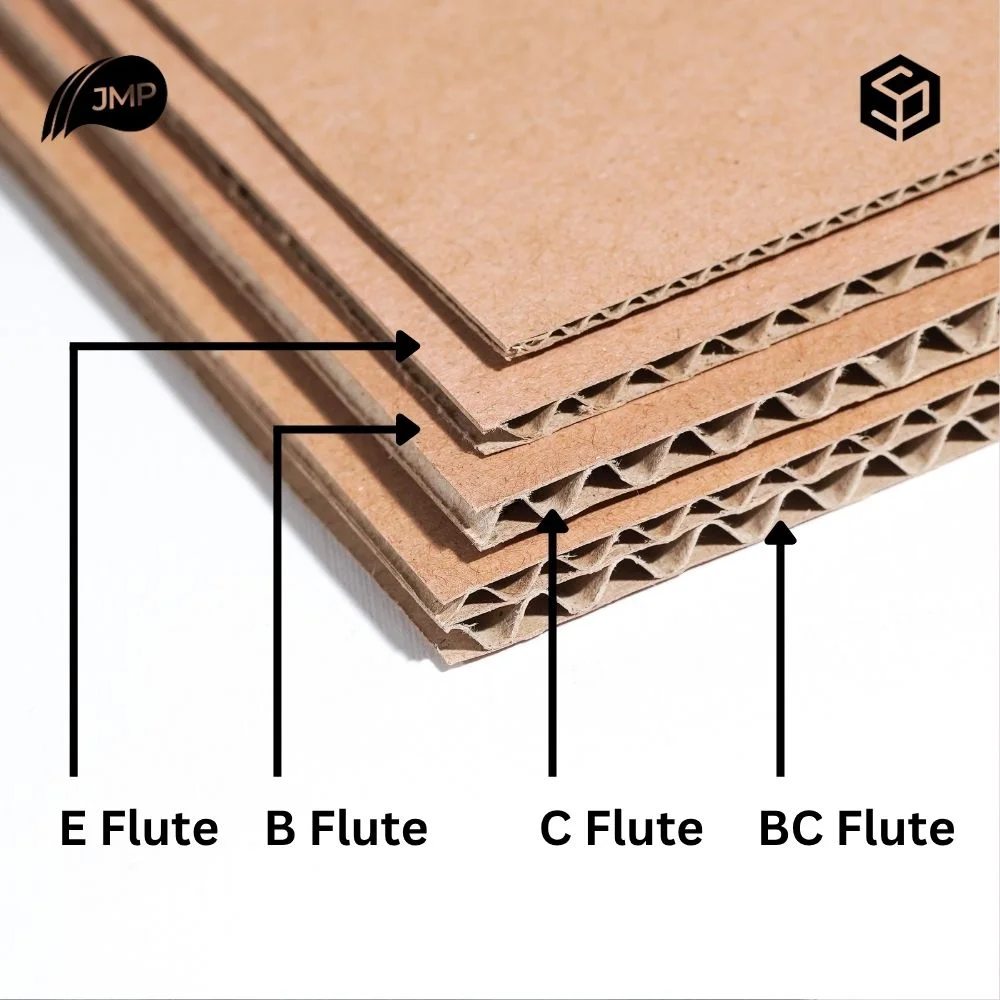
The order runs both ways at once: stacking strength rises from E to B to C to BC, and print-surface smoothness moves in exactly the opposite direction. That trade is the whole decision.
Those four are what we run — and only those four. We don’t run A flute or the EB combination. Most flute guides out there list six to eight profiles; if one of them has made it onto your technical drawing, say so early, so we can tell you honestly whether we can do it — rather than after the PO is issued.
One thing that regularly causes confusion about that second column: it is the total board thickness — the number you get putting a cut piece of sheet in a caliper, both liners included. The wave in the medium itself is a little lower than that (on B, around 2.5 mm of a ~3 mm total). So when a spec says “3 mm thick”, it almost always means B single wall, not a 3 mm wave.
Liner and medium grammage also drive the final strength, and that’s its own subject in the materials guide.
BC is a combination: one B layer and one C layer glued into a double wall. It is not “B times two” — two different heights are paired on purpose, so the tight one handles surface pressure while the tall one does the cushioning.
”Same box size — what’s the maximum weight per flute?”
It’s the natural question after that table. The honest answer: flute alone can’t answer it — and a supplier who hands you a kilogram figure per flute is guessing.
The estimate the industry uses runs roughly like this:
BCT ≈ 5.87 × ECT × √(wall thickness × box perimeter)
ECT comes from the paper — the grammage and grade of the liner and medium. Flute enters through wall thickness, and that thickness sits under a square root. The difference is large:
- Going from B (~3 mm) to C (~4 mm) on the same paper moves that root term by about 15%.
- Raising ECT from 32 to 44 — purely a paper choice — moves the result by about 38%, because ECT isn’t square-rooted.
So if you need a stronger box, changing flute is the small lever; the paper is the big one. Going up to BC does add strength, but you pay for two layers of flute to buy a gain you can often reach more cheaply through grammage.
And that paper lever has an advantage that’s easy to miss. Three grammages are commonly carried in the Indonesian market: 125, 150, and 200 gsm. Going from 125 to 200 adds only about 0.2 mm to the board — effectively invisible in the box’s external size. Going from B to BC adds about 4 mm per wall.
Which means: if your pallet pattern already fits and can’t change, paper is the only lever you have. The box gets stronger, the external dimensions hold, and nobody has to re-plan the truck.
One more thing: a BCT figure can’t be used directly as “the maximum weight you may stack on top”. It still has to be divided by a safety factor that follows how long the box stays stacked and how humid the warehouse is — the reasoning is in time under load below.
ECT values and their BCT equivalents are tabulated in Box Compression Test (BCT), and how to read grammage is in calculating carton base weight. The full calculation, from content weight through to a paper spec, is a piece of its own — we’ll write it separately rather than bolt it on as a footnote.
Flute direction: almost always missing from the spec
Flutes have a direction. In an RSC standing upright, they run vertically — from the bottom flap to the top flap. That isn’t an accident. Those small columns are only strong while they stand; lay the same box on its side and the columns become bridges. Stacking strength drops sharply, on an identical box.
Two practical consequences:
- If boxes get laid on their side in your warehouse to fit, the BCT figure on the test report no longer applies to that arrangement. The box didn’t change; its orientation did.
- If a box is genuinely designed to be used lying down — pulled from the side on an assembly line, for instance — that’s a design decision to state up front, not to discover after the box is made.
Why going up a profile isn’t automatically the answer
Moving from B to C, or C to BC, does add strength. Three things go up with it, and you pay for all three:
Paper. A taller wave needs a longer run of medium to cover the same distance, before you count the extra layers on a double wall. The material cost moves before the strength shows up.
Space. For the same internal size, a BC wall (~7 mm) adds about 8 mm to each external dimension compared with B (~3 mm) — two walls per dimension. Sounds trivial. Across one pallet row of five boxes that’s already 4 cm; enough to turn a pattern that fitted into one that doesn’t, and a tidy pallet into one with gaps.
Time under load. A BCT value is measured on a machine in minutes, with the load rising continuously until the box fails. In a warehouse, the same box holds a constant load for weeks, often at higher humidity. Its effective strength sits well below the test figure — which is why a correct spec always carries margin rather than sitting exactly on the number. How to read those figures is in Box Compression Test (BCT).
Flute and print quality
The taller the wave, the more it shows through the surface. Fine halftone printing over C or BC will reveal faint lines following the flutes underneath — a surface that should read flat ends up looking ribbed. For part codes, markings, and logos it’s a non-issue: the result on B is clean. For detailed artwork or dark solid blocks that have to stay even, E is the cleanest.
The printing methods themselves — screen, flexo, and digital, each with its own economic range — are in carton box process.
The machine limits that decide how big your box can be
Two numbers suppliers rarely raise up front, though both decide whether your design can be run at all:
- Flexo printing up to 4 colours.
- One whole blank through the maker: 1.5 × 1.0 m.
That second figure is the maker machine’s limit, not a limit on your box. Above it we still make the box — it runs on the flexo line, which prints up to 2.8 m, or the blank gets joined. What changes is the production route, not whether it can be done. Printing is almost never the thing that caps you.
What people rarely picture: an RSC blank is far wider than the box. Four walls in a row on one flat sheet, plus a glue lap:
- Blank length ≈ 2 × (box length + width) + glue lap
- Blank width ≈ box height + width
Put your own dimensions in. To go through the maker in one piece, box length + width has to stay under about 72 cm. So a 40 × 30 cm box still fits at any height, while 45 × 35 cm is 15 cm over — on five centimetres a side. Height is cheap; footprint is not.
One note that ties back to flute direction above: a blank can’t be rotated freely on the sheet. The flutes have to end up standing in the finished box, so the blank’s orientation is already fixed before the question of fitting is even asked. If your dimensions sit near or above this limit, send the drawing — it’s a five-minute check at our end, and we’ll tell you which route it takes.
Four questions that decide your flute
- How heavy is the content, and how high is it stacked? Heavier and taller pushes toward C, then BC.
- How long does the box sit under load? A day in a staging area is a different problem from six weeks in a humid warehouse.
- How detailed does the printing need to be? A smooth surface points to B or E.
- How tight are your truck space and pallet pattern? A slimmer profile saves real volume.
There’s no “best” flute. There’s the profile that fits the part, the load, the storage time, and the way you ship — and it genuinely depends on the box size and what it’s for. In our day-to-day work automotive parts most often land on C or BC; we use E and B where the box is small, the part is light, or the surface has to stay clean for printing.
What your RFQ should carry
So the answer comes back as a number rather than an estimate:
- Internal box dimensions (L × W × H) — or the part’s dimensions and weight if the box doesn’t exist yet
- Content weight per box
- Stack height in the warehouse and on the truck
- How long the box stays stacked
- Printed or plain; if printed, how many colours and how detailed
- A target BCT or ECT, if your customer has already set one
With those six, we set the flute — you don’t have to guess it. Don’t have all of them? A photo of the part plus a rough idea of how it stacks is enough to start costing.
At JMP the flute (E, B, C, and the BC combination) is set to match your part’s specification, not an off-the-shelf catalogue — made from zero, starting at 500 pcs. Send a photo or drawing of the part; we work out the structure first, then you decide.
Source: PT Jaya Mandiri Packaging (JMP) — carton box & polybag manufacturer for the automotive industry since 1990. jayamandiripackaging.com