There is a newer edition. A sixth wave landed in September 2026 — both producers raised again within six days of each other and, for the first time, named a possible Q4 increase inside the live letter. The current figures are in the September 2026 paper market report. This page still stands as the explanation of the mechanism behind this wave and the record for November 2025 – July 2026.
Over the last nine months, paper prices from the mills have gone up ten times. Not once down.
That is not a comfortable number to publish. But customers deserve to understand what is happening upstream before a price adjustment reaches their desk, not after. This is PT Jaya Mandiri Packaging’s own internal report, the one we use to plan raw-material buying, summarised for you.
To be clear up front: this page is information, not a price-adjustment notice. Adjustments for individual items go out through each customer’s own quotation, because the impact is not uniform across items — the fourth section explains why.
Ten increases, nine months, two producers
The two national paper producers that supply most of our containerboard have raised prices back to back since late 2025 — almost monthly, alternating between them. Five times each. We have anonymised both; that is standard commercial practice.
Paper price increases from the producers
Cumulative, November 2025 – July 2026
- Producer A
- Producer B
Scroll the chart sideways to see all of it.
View the data as a table
| Month | Producer A (cumulative) | Producer B (cumulative) |
|---|---|---|
| Nov 2025 | 1 | 0 |
| Dec 2025 | 2 | 0 |
| Jan 2026 | 2 | 1 |
| Feb 2026 | 2 | 2 |
| Mar 2026 | 3 | 2 |
| Apr 2026 | 4 | 3 |
| May 2026 | 4 | 4 |
| Jun 2026 | 5 | 4 |
| Jul 2026 | 5 | 5 |
What matters in that chart is not how high it goes. It is that no step goes down, and that the increases came from both producers — so this is a market condition, not one supplier’s policy you could escape by switching.
We do not publish the rupiah-per-kilogram figures here. Those are in the full report, which you can request below.
Five things driving it
None of this is local. Five factors, documented in paper-industry trade publications and the Indonesian financial press:
China’s recycled pulp policy (October 2025). China absorbed large volumes of Indonesian paper reels to feed its recycled-pulp demand. Domestic supply tightened and prices started climbing in late 2025. [1]
The Iran conflict and Strait of Hormuz disruption (2026). One of the world’s most important oil routes was disrupted. The effect compounds: freight costs rose, supply of recovered paper (OCC — the primary containerboard feedstock) was disrupted, and the petroleum-derived chemicals used in papermaking rose too. Indonesian containerboard prices have climbed month after month since. [1]
Global pulp prices reversed. Kraft pulp softened through 2025 — down 17.67%, reaching CNY 4,828/tonne in mid-December. Then it turned and hit CNY 5,526/tonne in early January 2026. A 14.5% swing in under a month. [2][3]
The rupiah weakened. From Rp 16,780 per US dollar in early January 2026 to around Rp 18,100 by late July — roughly 7.9% in one half-year. Pulp, imported recovered paper, and chemicals are priced in dollars, so a weaker rupiah feeds straight into rupiah input costs. [2][4]
Energy and regulation. Industrial energy and coal prices rose alongside geopolitical tension, and a carbon tax with a minimum rate of Rp 30,000 per tonne CO2e took effect in 2026. Both add to mill costs. [2]
- Global kraft pulp CNY 4,828 → 5,526 +14.5% per tonne 16 Dec 2025 → 8 Jan 2026 [2][3]
- Rupiah exchange rate Rp 16,780 → 18,106 +7.9% per US dollar 8 Jan → 29 Jul 2026 [2][4]
- US containerboard +US$100/ton net across 2026 After ~10% of North American capacity closed — 3.9 million tons, Feb 2025 – Mar 2026 [5]
That third tile is the one most often missed: this is not only an Indonesian story. North America retired nearly 10% of its containerboard capacity, and prices there rose a net US$100 per ton across 2026. [5] When a market that size tightens, paper flows toward it.
Why paper prices move box prices

For a carton converter, paper is the largest cost component in a box — typically 70–80% of production cost. Utilities (machine power, steam for corrugating) run about 10–15%, then glue, ink, labour and overhead. [6]
Cost structure of one carton box
Typical converter industry range — not JMP-specific figures
- Paper (liner + medium)
- Utilities
- Glue, ink, labour, overhead
Scroll the chart sideways to see all of it.
We are not an integrated paper mill. Every rupiah of paper increase lands directly in our production cost — there is no upstream buffer. Equity analysts note the same thing from the other side: integrated producers actually benefit from this rise, because they control input cost while enjoying higher selling prices. [2] Converters like us sit on the other side of that trade.
But here is the part that gets misread, and it matters: a raw-material increase does not mean box prices rise by the same percentage. Paper is the largest share, not the only one. The impact also differs per item, following the paper weight that box uses — the heavier the specification (double wall, high grammage), the bigger the effect. That is why adjustments go out per quotation rather than as one blanket percentage.
If a quotation raises prices far beyond the underlying material movement, that is worth questioning. So is a quotation that quietly goes down in a market like this — usually what has been cut is grammage, and what you lose is box strength. How to calculate carton base weight shows you how to check it yourself.
What rarely gets mentioned: demand is actually weak
This part rarely gets mentioned by any supplier, but it matters for your planning.
While paper prices climb, packaging demand in Indonesia is weak — purchasing power is under pressure and the rupiah has slid. Trade publications describe it as a chasm opening between rising prices and demand that is not following. [1]
Two practical consequences. First, this is not a market where stockpiling automatically pays; you can lock in material pricing but carry the risk of volume you never use. Second, the squeeze is real on both sides of the table — converters are not enjoying a rising market, we are compressing margin in the middle.
What is already visible for the rest of 2026
Trade publications record that the industry still anticipates further increases while OCC supply pressure, the exchange rate, and the geopolitical situation remain unresolved. [1]
In North America it is already more concrete than anticipation: one major producer has announced an increase of US$140 per ton effective 1 September 2026 — double the typical increment, and industry observers have called it unprecedented. [5]
We track this monthly, straight from the producers. If the next wave comes, you will hear it early — the same way this report went out ahead of any adjustment rather than after one.
What changed on our side
In fairness, here is what changed inside Jaya Mandiri Packaging’s own operation once this wave started. Three things, all of them numbers:
We cut quotation validity from 30 days to 14. Not a tactic to rush your decision. With paper moving almost monthly, a 30-day quote means guessing the material price three to four weeks out. Guessing wrong twice is enough to wipe out the margin on an order.
We shortened contract commitments from 6 months to 2–3 months for 2026. In 2024 a half-year commitment still made sense. It does not now. We would rather quote a price we can genuinely hold for two or three months than sign a six-month number we have to reopen halfway through — that is worse for you than a shorter but honest horizon.
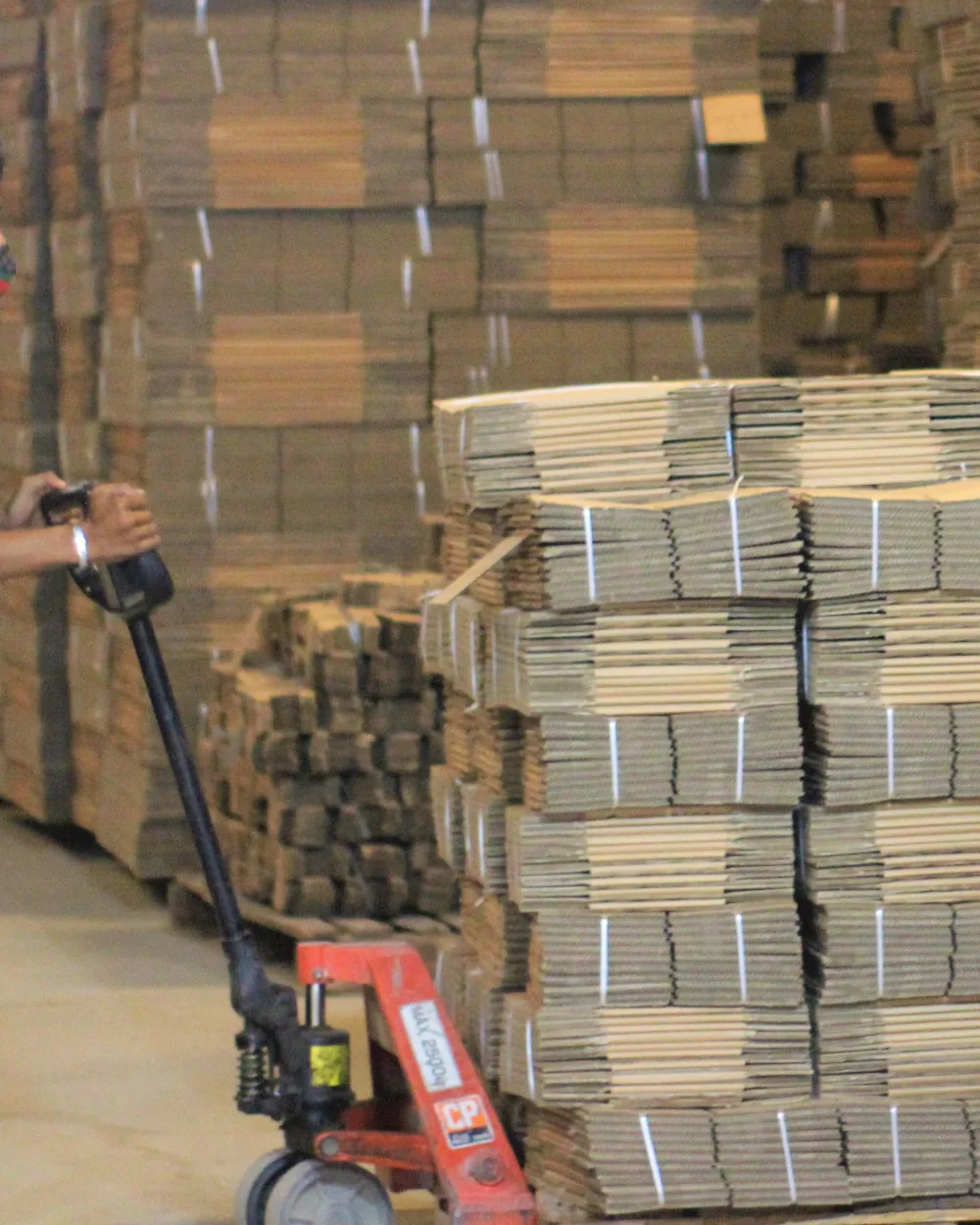
We hold far leaner stock, run against job orders. Stockpiling material into weak demand is a risk, not a safeguard.
And one thing we should say plainly: we cannot discount as deeply as we did in 2024. What we can do is make sure the price that goes out is fair and workable for you, then find the savings in the right place — in the specification, not in material quality. That is the next section.
Four things still within your control
World pulp prices are plainly outside both our hands. These are not:
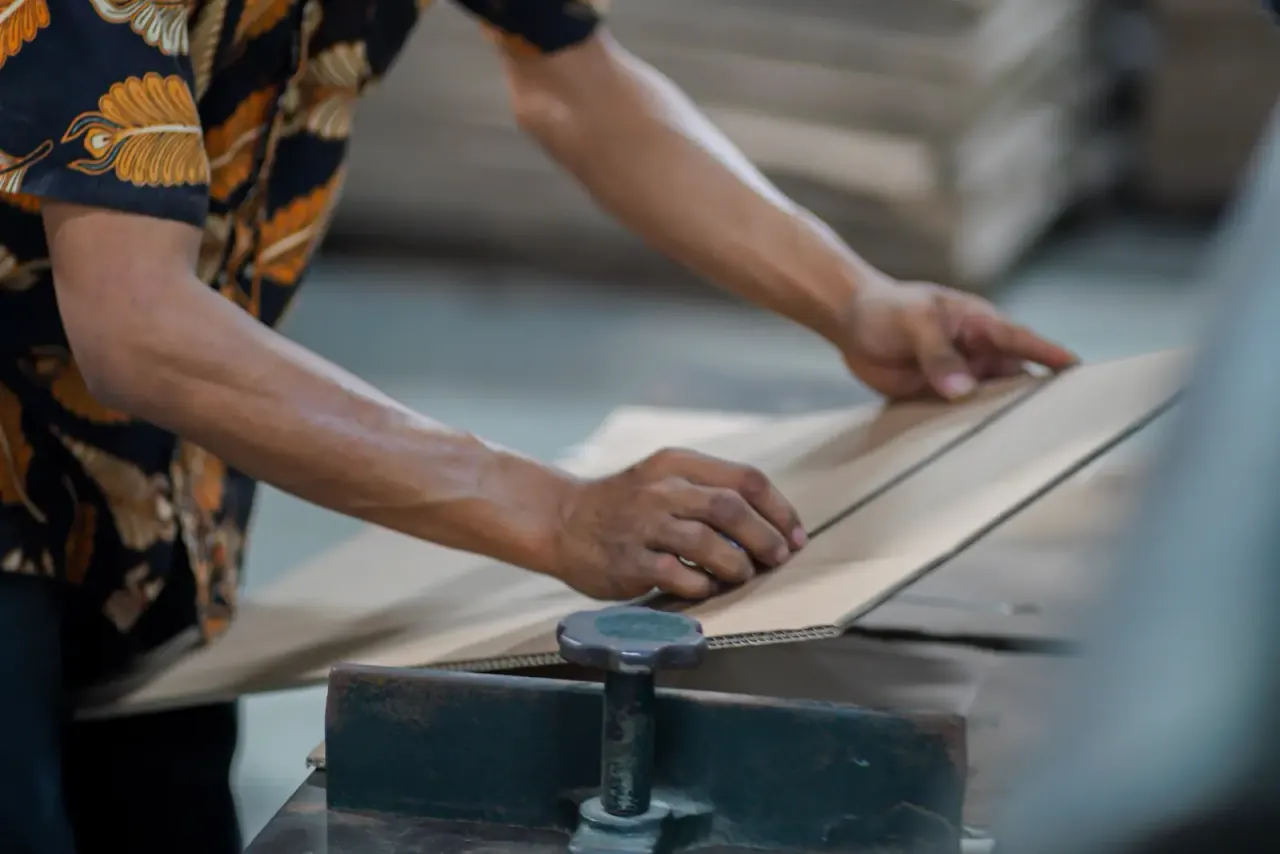
- The right specification, not an over-specified one. Correct grammage and flute protect your part without paying for paper you do not need. On our floor, over-specification — asking for double wall when single wall already carries the part load — is the cost most often removable without giving up protection. In a market where paper is 70–80% of cost, this is the biggest lever you hold — and the Jaya Mandiri Packaging team can review your material usage to find where the specification can come down without giving up protection. Flute selection guide.
- Lock volume and schedule — over a realistic horizon. A volume commitment with a clear schedule still gives a steadier price basis than buying spot each time, and lets us plan material earlier. The difference from 2024: for 2026 we offer it in 2–3 month blocks rather than 6 — see the section above. Because our custom runs start at 500 pcs, you can order to real demand instead of over-ordering to clear someone else’s large MOQ.
- Flex-Stock (VMI). We hold your packaging stock and ship against call-off. Cost can be locked at the order point and the warehousing burden moves to us — which matters more, not less, when demand is uncertain. See the Flex-Stock programme.
- A transparent escalation clause. If your contract has a price-adjustment clause, make sure it is based on a clear material index and works in both directions — not a one-sided number that only moves up. Check this now, before the next wave.
Request the full report
The full version contains what we do not publish here: the month-by-month increase table with rupiah-per-kilogram figures, per producer, from November 2025 through July 2026 — plus the cumulative total and the underlying sources.
Send your box specification along with it if you want the PT Jaya Mandiri Packaging team to show you where cost can still be locked down — with numbers, not promises.
Sources
- Fastmarkets, “Chasm looming between packaging demand, supply for Indonesia’s containerboard industry”, 2 June 2026 — China’s pulp policy; the Iran/Strait of Hormuz impact on OCC, freight and chemicals; monthly Indonesian containerboard increases; weak packaging demand.
- Kontan, “Prospek Emiten Kertas Ditopang Ekspansi & Kenaikan Harga Pulp”, 8 January 2026 — pulp at CNY 5,526/tonne; Rp 16,780/US$; carbon tax minimum Rp 30,000/tonne CO2e; the advantage held by integrated producers.
- Kontan Insight, “Harga Bahan Baku Melemah, Prospek Emiten Kertas Cerah”, 17 December 2025 — kraft pulp at CNY 4,828/tonne as of 16 December 2025, down 17.67% across 2025.
- Daily exchange-rate reporting, July 2026 (Bisnis.com, Media Indonesia, Suara.com) — rupiah at Rp 18,011 (8 July), Rp 18,070 (28 July), Rp 18,106 (29 July) per US dollar.
- Packaging Dive, “Containerboard prices rise in June following second round of producer hikes”, June 2026, and follow-up reporting — net US$100/ton increase across 2026; ~10% North American capacity closure (3.9 million tons, Feb 2025 – Mar 2026); the US$140/ton announcement effective 1 September 2026.
- Corrugated box manufacturing cost analysis, Q2 2026 — kraft paper as the largest cost component (~70–80% of operating cost), utilities 10–15%.
Data in this report is current to July 2026. Each further wave is published as its own edition rather than as an edit to this page, so the earlier figures stay traceable. Latest edition: September 2026 paper market report.
Source: PT Jaya Mandiri Packaging (JMP) — carton box & polybag manufacturer for the automotive industry since 1990. jayamandiripackaging.com